What the translator reads
The parser handles PAS, CAMIO, PC-DMIS and generic DMIS 5.x files, UTF-16 encoded ones included. Feature definitions, datum definitions, alignments, tolerances and output statements become steps of an Ai-Inspect program. Where the CMM program defines a feature by its nominal only, the measurement points are synthesised on the scan from that nominal.
- PAS, CAMIO, PC-DMIS and generic DMIS 5.x dialects
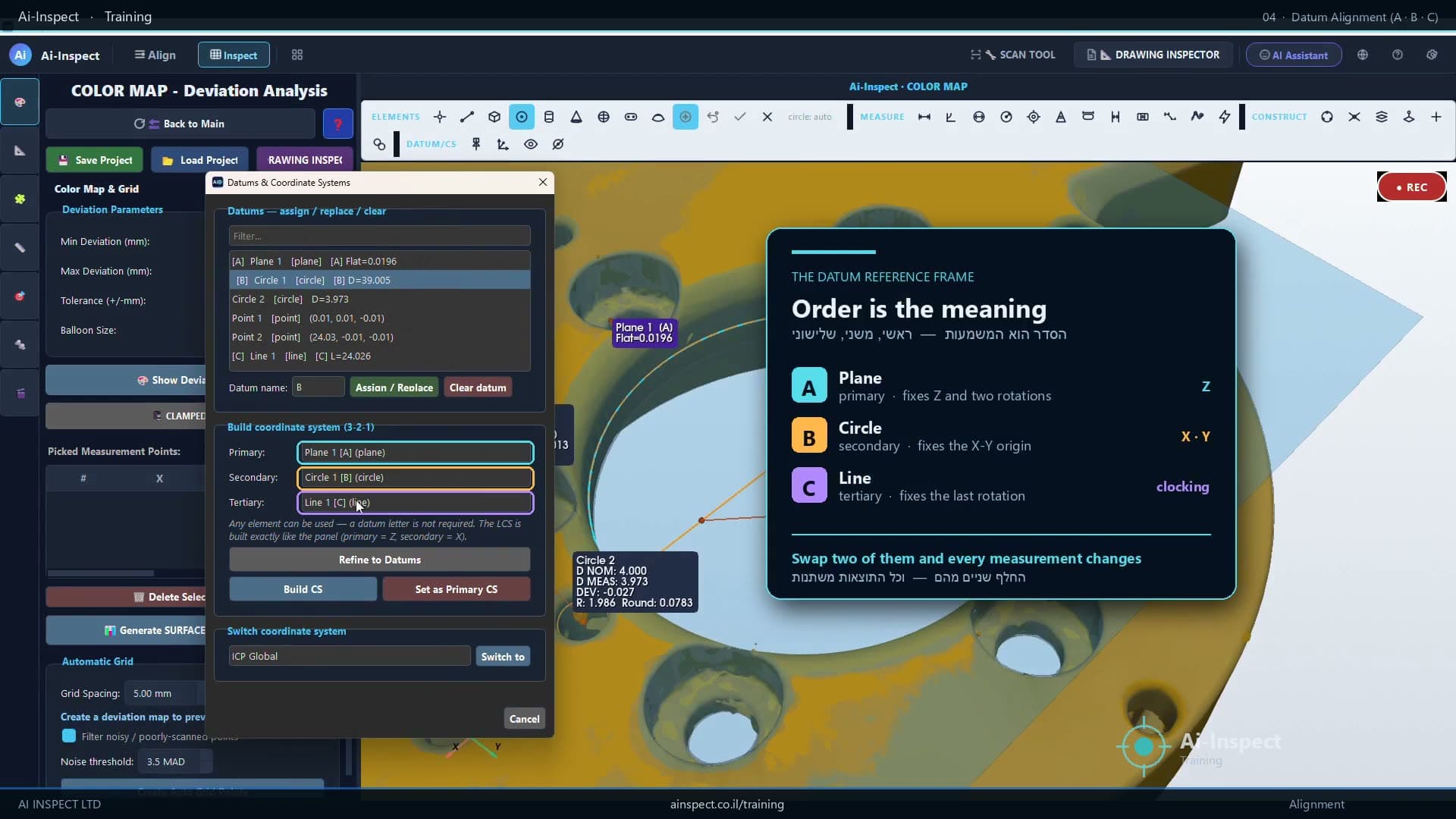
- Datum alignments rebuilt step by step
- Measurement points synthesised from nominals where the program has none
- Program repair tools and a macro editor for steps that need attention
Datum frames are verified, not assumed
A CMM program moves through several coordinate systems. The translator reproduces those transforms so that each feature is measured in the frame the program intended. Before the program runs, a frame-registration gate checks that the datum frame lands on the part; a frame that cannot be verified is flagged for the operator's confirmation instead of being used as it is.
After the run
The run report lists every balloon that was not measured and why — no scan coverage, a datum that failed, a tolerance the mesh cannot resolve — and marks it in red on the model. The Measurement Copilot then goes through the open items one at a time. Results export as PDF, Excel and CSV, and as a PAS CMM CSV for shops that keep their records in PAS.
Which characteristics stay on the CMM
A characteristic whose tolerance is tighter than the scanner can resolve is refused by the software and remains a job for the touch probe. Many shops run the same program in both places and let the refusals show which characteristics still need the CMM.